

Go to page content

Exercise stress tests

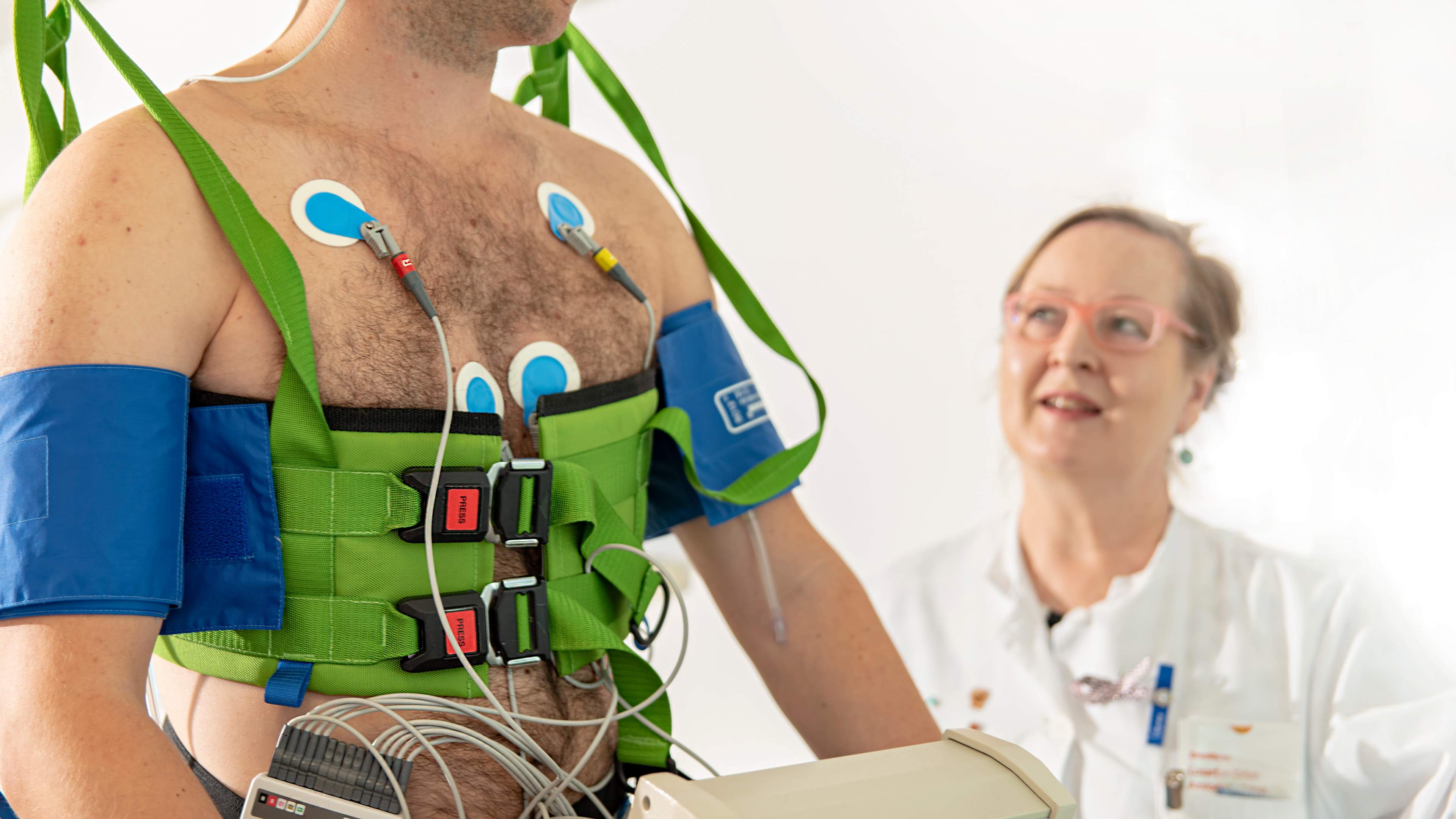
Exercise stress tests are used to examine heart diseases, cardiac circulation, and pulmonary function during physical exertion.

Depending on the type of examinatio and the clinical situation, a stationary bicycle, treadmill, or arm crank may be used. 

Types of exercise stress tests include: 

  • Clinical exercise stress test 

  • Spiroergometry 

  • Blood flow measurement in lower limb arteries during exercise (ABI stress test) 

  • Stress echocardiography  

During the test, blood pressure and ECG (electrocardiogram) are monitored. Measurements may be taken before, during, and after exertion. The workload is increased gradually. The examination is always conducted under supervised conditions, and a physician is present throughout. The unit performing the examination will provide detailed instructions for preparation. 

Watch the video: Exercise stress tests. The video is produced by HUS and includes subtitles in Finnish, Swedish, and English.

The clinical exercise stress test assesses the function of the respiratory and circulatory systems and measures physical performance capacity. The test is performed using a standardized method by pedaling a bicycle against gradually increasing resistance until exhaustion. ECG and heart rate are monitored, blood pressure is measured, and the lungs and heart are auscultated.  The clinical exercise test is used to assess: 

  • Coronary artery disease 

  • Behavior of arrhythmias 

  • Physical performance capacity 

The test lasts approximately one hour, with 5–15 minutes of actual exertion. A physician and nurse are present throughout the test. 

If you experience severe chest pain or if any abnormalities are detected in the ECG during the test, it will be discontinued. 

The physician who referred you for the examination will inform you of the results and the next steps in your treatment. Contact the treating unit if you do not have a scheduled appointment or call time. 

The spiroergometry test is conducted similarly to the clinical exercise stress test, but during exertion a mask is placed over your face to measure oxygen and carbon dioxide concentrations in exhaled air as well as respiratory volumes. ECG and blood pressure are also monitored. Pulmonary function tests may be performed at the beginning and end of the test.  

Spiroergometry is used to examine: 

  • Causes of symptoms limiting performance 

  • Dyspnea during exertion 

  • Physical fitness prior to surgery 

  • Work capacity 

The test lasts approximately 1.5 hours, with 5–15 minutes of exertion. If you experience severe chest pain or if any abnormalities are detected in the ECG during the test, it will be discontinued. 

The physician who referred you for the test will inform you of the results and the next steps in your treatment. Contact the treating unit if you do not have a scheduled appointment or call time.  

This test assesses the presence, severity, and treatment response of lower limb arterial circulation disorders. Blood pressure is measured in the arms and legs while lying on an examination table. After the resting measurement, you will walk on a treadmill, followed by repeated blood pressure measurements. The test lasts approximately one hour. 

 ABI stress testing is used to examine: 

  • Intermittent claudication 

  • Peripheral arterial disease in the lower limbs 

The physician who referred you for the examination will inform you of the results and the next steps in your treatment. Contact the treating unit if you do not have a scheduled appointment or call time. 

Stress echocardiography provides information about the structure and function of the heart. The ultrasound device allows detailed examination of heart chambers, wall motion, valve structures, and their function. 

Stress echocardiography is used to examine: 

  • Coronary artery disease 

  • Heart diseases 

  • Patients with myocardial infarction 

The stress echocardiography is performed similarly to the clinical exercise stress test. In addition, an ultrasound examination is performed at rest, during exertion, and after exertion. During the test, your condition, symptoms, ECG, blood pressure, and respiration are monitored. The test lasts approximately 1.5 hours. 

The physician who referred you for the examination will inform you of the results and the next steps in your treatment. Contact the treating unit if you do not have a scheduled appointment or call time. 

Updated 6.11.2025