

Go to page content

How palliative care and hospice care is organised

According to the recommendations of the Ministry of Social Affairs and Health, palliative care and end-of-life care are tiered based on need into basic and specialized services.

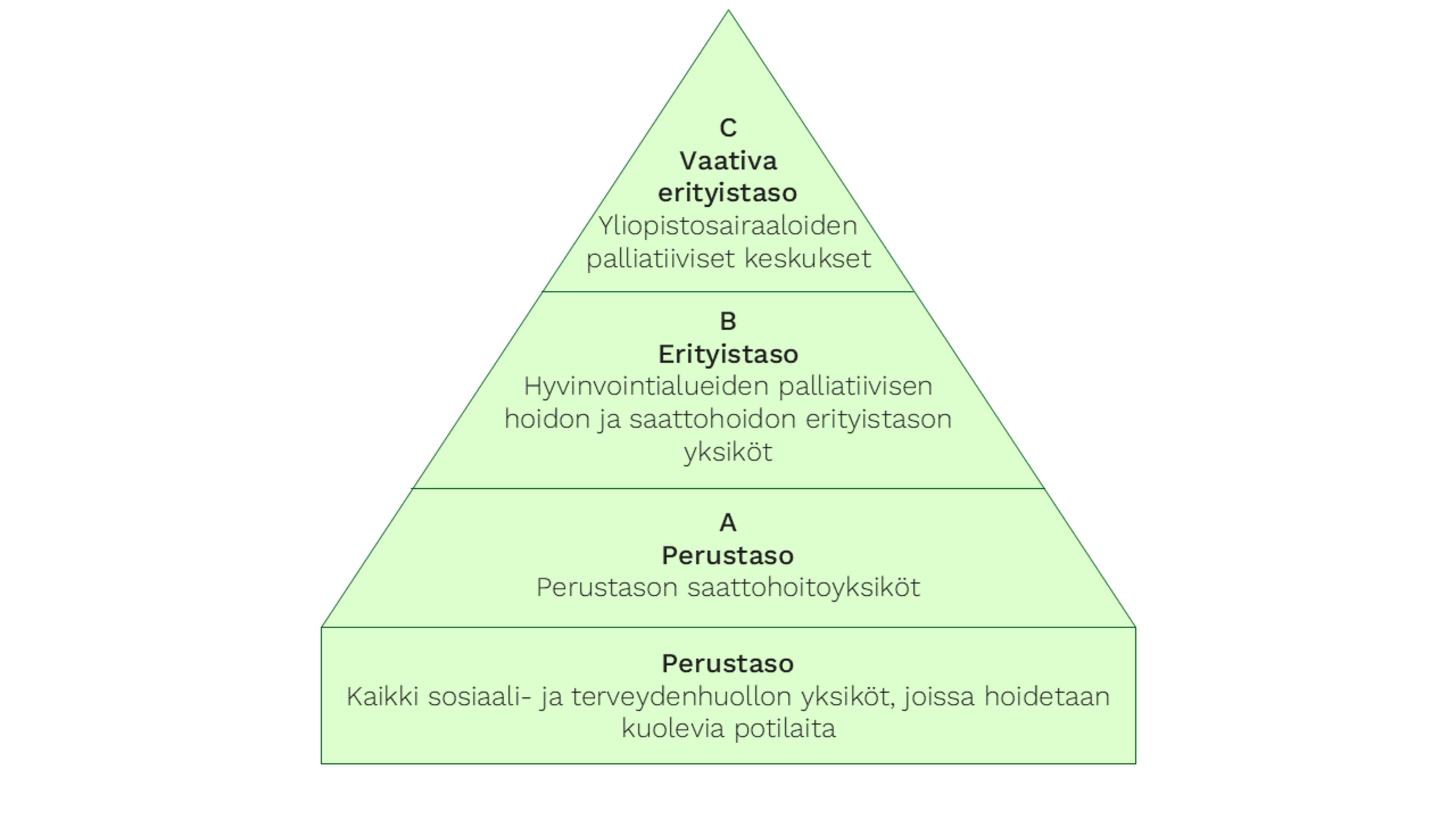
The three-tiered model for palliative care and hospice care. STM 2019:14.

Palliative care is organised into tiers based on the patient’s needs, and integrated into the current healthcare system. The services are divided into “basic level” competence, as well as three tiers:

  • A – hospice care units at the basic level

  • B – special level palliative care and hospice care centres

  • C – demanding special level palliative centres.

Some wellbeing services counties have already adopted the model.


Competence of professionals

Palliative care and hospice care competence is a part of the basic skills of every social welfare and healthcare professional. According to recommendations by the Ministry of Social Affairs and Health, social welfare and healthcare professionals will have more palliative care and hospice care competence in the future, in order to provide appropriate, high-quality care in all healthcare and social welfare units. The aim is to ensure competent palliative care and hospice care equally to all those who need it, regardless of where they live..

Tiers of care

In the three-tiered model, palliative care and hospice care services are built on the foundation formed by basic-level services.

The basic level consists of all social welfare and healthcare units except for those belonging to tiers A, B, and C. These include inpatient wards in health centres and hospitals, home care units, service housing with 24-hour assistance in units under social welfare services, residential home for the elderlyand other units with 24-hour assistance in which patients are cared for until the end of life. The basic level requires competence in the basics of palliative care and hospice care, as well as the ability to make an advance care plan and the decision to move into hospice care.

The purpose of the basic level is to ensure palliative care and hospice care to patients whose symptoms are generally steady, and for whom it’s possible to predict the needs for care and support with an advance care plan. The care is carried out as multiprofessional teamwork.

Level A consists of healthcare units that have included the development of hospice care as one of their basic functions alongside other activities. The units take hospice care into account in their staff-patient ratios, trainings provided to personnel, and the operating environment (beds reserved for hospice care).

Units fulfilling the quality criteria of level A can be found in primary healthcare as well as in specialised healthcare. The personnel have a higher level of competence in pallaitive care and hospice care than those working on the basic level, and the unit has the capacity to begin hospice care, even under demanding circumstances, with the support of special level units if necessary.

The special level B service network is made up of units specialised in palliative care and hospice care within wellbeing services counties, coordinated by the palliative centres of the wellbeing services counties. Palliative care and hospice care are the primary task of these special-level units, and the personnel have received special training.

Special-level units include palliative home hospitals and their support departments, palliative inpatient wards, hospice care wards, hospices, palliative care consultation teams in hospitals, and palliative outpatient clinics. The special level must also be able to provide psychosocial, spiritual, and existential support. Special-level units provide basic-level units with consultation support.

Patients who require special-level care have a rapidly progressing illness or symptoms that are difficult to manage. Their care requires expertise, and due to rapidly changing situations, palliative care and hospice care specialists are within reach around the clock.

Demanding special level C comprises palliative centres in university hospitals, made up of palliative care outpatient clinics, units for psychosocial support, palliative wards, home hospitals, day hospitals, and hospices or hospice care wards comparable to them. The centres in university hospitals are responsible for demanding special-level palliative care and hospice care.

The palliative centres in university hospitals are responsible for coordinating palliative care in their respective collaborative areas (Southern-, Western, Eastern, Inland, and Northern Finland)- ja Pohjois-Suomen yhteistyöalueet) in terms of availability of care, hospice care plan,service chains, 24-hour consultation support, and implementation plans concerning palliative care and hospice care for children and young people.

Additionally, university hospitals are responsible for educating and training doctors and the nursing staff on palliative care and palliative medicine in collaboration with vocational institutions and the faculties of medicine in universities, and for research and development of care.

Updated 27.6.2025